

Get a fast quote
Tell us what's backing up. We answer fast — a real person, not a call center.
The plain version
What epoxy pipe lining / cipp is
Epoxy pipe lining — cured-in-place pipe, or CIPP — rebuilds a failing line from the inside. An epoxy-saturated liner is drawn into the cleaned host pipe, pressed against its walls, and cured into a hard, jointless new pipe. It is a structural pipe within the pipe, not a coating.
This is one of our two no-dig methods, and it is the one that uses the pipe you already have. The work happens through existing access points, so the line under your slab, your pool deck, or the tree you are not willing to lose can be renewed without opening the ground above it — and it can treat a defined section rather than the whole run.
When you need it
Any one of these is reason enough to have the line looked at.
- The failing section runs under a slab, addition, pool, or hardscape you will not open
- Camera footage shows cracks and root-damaged joints in a line that still holds its shape
- Root intrusion keeps returning at specific joints
- You want decades more service from the line without replacement-scale disruption
- A landlord or HOA needs the fix contained and the surface untouched
On the day
How the job runs
Qualify the host pipe
Lining needs a host that still holds its round — camera and measurements confirm the line can be lined and exactly which footage needs it.
Clean to bare wall
Jetting and root cutting strip the host pipe to its original diameter. A liner is only as good as the surface it bonds against.
Install and cure
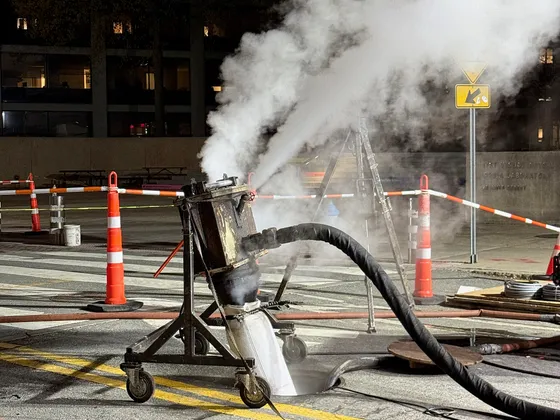
The saturated liner goes in through existing access, is inflated against the host walls, and cures in place into a rigid new pipe.
Reinstate and verify
Branch connections are reopened from inside, and the final camera pass shows a smooth continuous wall end to end. You keep that footage.
Money, plainly
What it costs
Lining is priced per lined section — length, diameter, and the number of branch connections to reinstate drive it. Access matters less than with any digging method, which is the point.
Against open excavation under a slab or hardscape, lining usually wins decisively once you count the concrete, the restoration, and the days of disruption a trench through them costs. In open lawn on a shallow line, honest math sometimes favors the dig — and we will say so.
Why Rooter-X for this
Lining is a craft with a wide quality range, and the difference is preparation — we clean to bare wall and measure before a liner ever goes in, because a liner bonded over grease is an expensive sticker.
Every lining job ends with recorded proof: the same camera that found the cracks shows the new wall covering them.
Asked constantly
Questions we hear
Does lining reduce my pipe's capacity?
The liner takes up a small amount of diameter, but its cured wall is far smoother than aged clay or cast iron, so flow typically improves rather than suffers. Water cares more about surface friction and continuous grade than about a few millimeters of radius.
How long does a cured liner last?
Epoxy liners are engineered as structural pipe with design lives commonly rated at 50 years. The cured resin is jointless — and joints, not pipe walls, are where old clay lines fail first.
Can you line just the bad section instead of everything?
Yes — sectional lining treats a defined stretch, which is one of lining's real advantages over full replacement. If the rest of the run is sound on camera, you pay to fix what is broken, not what isn't.
What happens to my branch lines when the liner covers them?
Reinstatement — reopening each branch connection through the cured liner from inside the pipe — is part of the job, and the final camera pass shows each junction open. A lining bid that does not mention reinstatement is a bid worth questioning.
When is lining the wrong choice?
When the host pipe has lost its shape — a collapsed or badly deformed line gives the liner nothing to form against — or when grade is the underlying problem, because lining follows the existing pitch, sags included. Those cases point to boring a new line or to excavation, and the footage makes the case either way.
Related services
Talk to us about epoxy pipe liner (cipp).
A real person answers, and the first step is always looking, not selling.