

Get a fast quote
Tell us what's backing up. We answer fast — a real person, not a call center.
The plain version
What water heater installation is
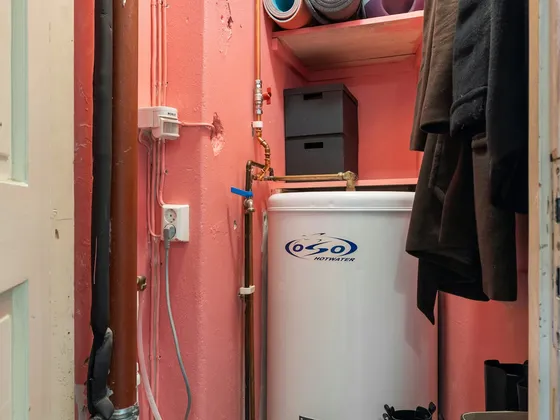
When a tank water heater reaches the end — rust in the hot water, a leak from the tank body, or simply a decade-plus of service — replacement is usually a same-day job, and doing it correctly is mostly about unglamorous details: matching capacity to the household, venting it properly, and meeting the code items California actually enforces.
A code-correct installation here includes seismic strapping at two points, properly anchored, because this is earthquake country. It also includes a temperature-and-pressure relief line routed to a safe termination, a drain pan where the location calls for one, and a permit where your city requires it. Skipping those saves an hour on installation day and costs real money at a resale inspection — or more than money, when the shortcut is the one that mattered.
And when your existing heater is not actually finished — a failed part on a young tank — we say so and repair it instead. Selling steel that was not needed is a worse outcome for us than a smaller invoice.
When you need it
Any one of these is reason enough to have the line looked at.
- Water pooling under or around the tank — a tank-body leak has no repair
- Rust-tinted hot water at the taps
- The unit is past ten years old and acting its age
- Hot water runs out faster than the household actually grew
- An escrow or insurance inspection flagged strapping or the relief line
On the day
How the job runs
Confirm the tank is done
The serial number dates the unit and the symptom pattern separates a dead tank from a fixable part. If repair honestly wins, that is the recommendation you get.
Size and quote flat
Household size, fixture count, and recovery needs pick the capacity — not whatever is on the truck. The written price covers the unit, the code items, and haul-away.
Install to code
Set, connect, and vent the new unit; strap it for seismic; route the relief line; add the pan where required. Permit and inspection happen where your city calls for them.
Verify and haul away
A full heat cycle and every connection checked before we leave — and the old tank leaves with us rather than sitting at the curb.
Money, plainly
What it costs
The installed price is the unit plus its surround: capacity and fuel type set the base, and venting changes, code catch-up items, and location access move it from there. A like-for-like swap in an accessible garage is the friendly end; relocating a unit or correcting decades of improvisation is not.
Treat a very low phone quote with suspicion — it is usually the price of a tank without the code items, which reappear as day-of additions once your old heater is already disconnected. Our number is written, includes the boring parts, and holds.
Why Rooter-X for this
We triage honestly before selling steel: a thermocouple on a six-year-old tank is a repair, and we will happily make it one.
Every install leaves code-complete — strapped, relieved, panned, permitted where required — because the inspection that matters might be years away, at your resale.
Asked constantly
Questions we hear
How long should a tank water heater last?
Eight to twelve years is the honest range for most tanks, with water quality and maintenance moving the needle. Past ten, every repair decision should include the age — not because repairs stop working, but because the tank body itself is on a countdown no part can reset.
Repair or replace — how do you actually decide?
Age weighed against repair cost. A rough rule we stand behind: under eight years old with a failed component, repair it. Over ten with anything beyond a trivial part, price the replacement before authorizing the repair. Tank-body leaks and rusty hot water decide by themselves — those tanks are finished.
Do I really need a permit to replace a water heater?
In most Orange County cities, yes. The inspection checks exactly the safety items that matter: strapping, the relief line, venting, and gas connections. It is inexpensive relative to the job, we handle the paperwork, and an unpermitted install is a classic escrow snag years later when you sell.
Can I go bigger than my current tank?
Usually, within limits — space, venting, and gas supply all get a vote. Before upsizing it is worth asking why you are running out, because a failing dip tube or heavy sediment can make a healthy fifty-gallon tank behave like a thirty. We check that first; buying capacity to compensate for a fixable fault is the expensive answer.
Should I switch to tankless instead?
Possibly — it is a different project with different economics, and we install those too. If your usage genuinely points that way we will tell you rather than force a tank into the space. Our tankless installation page lays out the sizing, venting, gas-line, and maintenance realities so you can compare honestly.
Related services
Talk to us about water heaters installation.
A real person answers, and the first step is always looking, not selling.